You can read the press release from the University of Colorado, Denver here.
First, it should be duly noted that the research occurred at the Children's Hospital on the Anschutz Medical Campus in Aurora, Colorado. It also services Denver. The college is one of the best medical and teaching hospitals in the nation, so I imagine they get in cases from across the state and country.
Aurora and Denver both have Pit Bull bans. Denver has the highest rate of dog bite hospitalizations in the state. This could be a reason you do not see Pit Bull bites in the study, but I do not believe this to be the case. Denver still kills 800-1,000 Pit Bulls a year so they certainly still exist and are still being owned by people.
The study covered 537 facial bites to children between 2003-2008. This is not an all-inclusive dog-bite study, to be sure. Nearly 70% of the victims were under the age of 5. The dogs were mostly known entities, that is they were not victims of stray or loose dog attacks. I'm not sure I agree with the assertion that 50% of all people will get bitten and 80% will be in the facial region - I'd like to see the reasoning for this statistic.
Showing posts with label research. Show all posts
Thursday, November 11, 2010
Wednesday, March 24, 2010
Sperm More Popular Than Homosexuality
The study of homosexuality in nonhuman animals is woefully understudied. It is perhaps one of the few truly controversial research subjects.
But sperm is not!
Search pubmed for "sperm" and you will garner 77,926 results. Ovaries are more popular, though, with 116,000 results. Search for "homosexuality"or "homosexual behavior" and you'll get less than 20,000 results and almost ALL have to do with humans.
I should not find this surprising. By all accounts, a small percentage of between 500-1,500 species exhibit homosexual behavior. About 50% of males produce sperm! I cannot explain why ovaries are way more popular than sperm, except that ovaries rule and sperm drool. I kid. Sperm cannot drool.
Anyways, so NPR turned a neat phrase: Sperm of a feather flock together. I love this and have been telling everyone about it. You do not often get to say that with a straight face (or while sober, you probably don't say it inebriated, either). Turns out when a female copulates with multiple males, the sperm of each male herd up and hang out with one another. See the dyed sperm here. They're actually quite pretty. In another recent publication, researchers genetically modified fruit fly sperm so their heads glowed different colors. That's crazy. They did this study because the female reproductive tract is super mysterious. So mysterious that we have to modify the genes of sperm to reveal its hidden something or other.
Consider yourself enlightened. Sperm of a feather flock together, and glow in the dark sperm - you may want to hold your breath - are constantly on the move. Breaking news.
Monday, October 19, 2009
Description of the behavior of dogs by experienced & inexperienced people
How people interpret dog behavior has always fascinated me (heck, how *I* interpret dog behavior fascinates me, heh).
A few years ago, I noticed a couple outside a coffee shop allowing two unknown dogs to greet on leash, nose to nose. This is what the two dogs looked like:
- Standing up on tippy-toes
- Stiff body posture
- Ears pulled forward
- Hackles up on both dogs
- Tails flagging (waving fast, with one dog who had a still lower tail and a fast moving tip) with tail arched as high over back as physically possible (both dogs were 20lb mixed breeds).
Both were about the same size, height and body structure. I noticed that the dog closest to me appeared ready to take on the other dog, he was leaning forward more so than the other dog, was a lot more tense. Because dog fights are scary, nasty things, even if they last for three seconds, I tried to politely tell the couple they might want to distract their dogs, to avoid a fight.
Oh, but they're wagging their tails. They're just happily greeting each other!
Plus they gave me nasty looks as if I was trying to disrupt the order of things. No sooner had I shrugged my shoulders and was about to walk past them, the dog closest to me had had enough of the staring contest. He launched his teeth into the other dog. Screaming ensued, chaos! horror! END OF THE WORLD! Both owners tugged at the leashes, separating the dogs to check them over. No bite wounds, no punctures. I am always amazed at how, more often than not, dog fights are more about finding ways to shove and push and convey messages without doing bodily harm. I've seen more damage on my dogs after an intense play-wrestle bout.
It highlights how even people with dogs can be insensitive or ignorant of the signals their dogs are trying to convey. We mess things up majorly. We ignore subtle cues, goggle at overt cues as if they came out of nowhere, and we blithely confuse play behaviors with aggressive behaviors with fear behaviors. What I've wondered is what kinds of behaviors do people, both dog-savvy and dog-ignorant, easily comprehend and what behaviors do people constantly confuse.
Recently, researchers from Italy and the UK published a study in Applied Animal Behaviour Science entitled "Description of the behavior of domestic dog (Canis familiaris) by experienced and inexperienced people". This is, by no means, the end-all study on how people perceive dog behavior. It is a jumping point for further research, and the discussion includes all the ways in which this study could be improved upon or if there were possible issues with the results provided.
Regardless, the results are interesting.
The study involved nine taped video sequences between two dogs. Eight dogs* were filmed during their first contact with a "stooge dog", a mid-age female Border Collie. She was, for all intents and purposes, the "control" dog, although she was used as the "focal" dog in one interaction. The focal dog was always kept stationary, on leash, as the stooge dog approached. Filming occurred in public parks and time of taping started 10 seconds before the Border Collie entered the camera's frame until the end of the interaction. For the safety of the dogs and owners, aggressive contact interactions (as predicted by the experimenters) were not permitted. Unfortunately, no video was available, which would make reading this study a lot more provocative!
Recordings were then shown to sixty observers who were categorized as dog trainers, veterinarians, dog owners (>2 years) or non-owners (no dog ownership). The viewers saw each video twice, once without sound, once with sound. Subjects were asked to rate the behavior of the focal dog towards the stooge dog. Specifically, they were asked to rate indifference, fearfulness, confidence, friendliness, submissiveness, defensiveness, playfulness, aggression. Observers then had to choose one of the behavioral styles as the primary style and further define what behaviors made them select that particular behavior style.
Indifference, fear, friendliness and play solicitations were easily identified. Actual-play behavior, confidence and aggression were behaviors that people, especially non owners, had a difficult time correctly identifying.
For example, when both dogs were engaged in actual play, only 30% of observers correctly identified the predominant behavior as "playful". 43% identified it as aggression and 20% as confident behaviors. When viewers were showed a clip of a confident dog, only 38% correctly identified the behavior as confidence, while 43% identified it as friendliness (and the two can very well overlap, as the researchers discuss). What I found interesting is that 38% of people correctly identified aggression while 33% of the viewers, when shown the same clip, identified the behavior as friendliness and 13% as confidence.
90% correctly identified indifference (eye aversion, sniffing, sitting still, positioning body away from stooge dog), 73% correctly identified friendliness, 62% correctly identified play solicitation, 67% correctly identified fear (although 10% identified it as indifference) and 53% correctly identified defensiveness.
The researchers asked people to identify the primary body part they used to measure behavior. 23% used the tail, followed by muzzle-related cues (19%) and large body movements (18%). Tail movement, e.g. tail wagging, was used 75% of the time over position of tail and frequency of tail movement. And generally speaking, tail movement was associated with friendliness and play. Observers strongly associated barking with aggression, including when watching play behavior. People considered growling a more defensive behavior, biting was associated with aggression and play, and showing teeth was mainly described as aggression or defensiveness. Sniffing was generally associated with friendly and confident behaviors. Pulling on the lead tended to be primarily associated with aggression and confidence. Ear position was the least used cue.
When showed the actual play clip, biting, herding, piloerection, standing over/showing teeth were all considered aggressive, while an upright stance and straining at the lead indicated confidence. And when showed the aggression clip, barking, bouncing, ears erected/forward, tail wagging were read as signs of playfulness!
The researchers then discuss some of the limitations of the study (you can purchase the study and read for yourself).
So how do we get non owners and novice dog owners (with little education on behavior) to understand cues better? People still rely on highly generalized behaviors to identify behavior; e.g. a wagging tail indicates a friendly dog; hackles = aggression; barking = dangerous, etc. I find it a little disconcerting that people (novice dog owners included) mistake aggressive behaviors for friendliness.
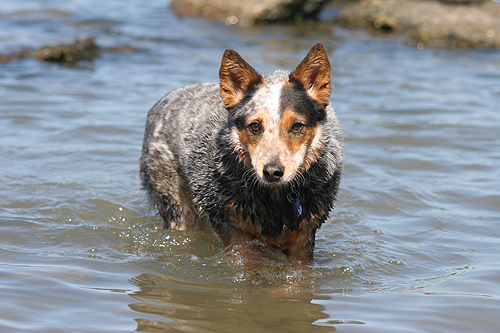
For fun, tell me what you see in this pictures:
Pic A (Click for larger, result from "barking dog")
Pic C (click for larger, result from "dog play")
Pic D (click for larger, result from "dog fight")
Pic E (Should be obvious!)
* Cross breed, Greyhound, Boxer, Labrador Retriever, Springer Spaniel, German Shepherd, Border Collie, Cross breed
A few years ago, I noticed a couple outside a coffee shop allowing two unknown dogs to greet on leash, nose to nose. This is what the two dogs looked like:
- Standing up on tippy-toes
- Stiff body posture
- Ears pulled forward
- Hackles up on both dogs
- Tails flagging (waving fast, with one dog who had a still lower tail and a fast moving tip) with tail arched as high over back as physically possible (both dogs were 20lb mixed breeds).
Both were about the same size, height and body structure. I noticed that the dog closest to me appeared ready to take on the other dog, he was leaning forward more so than the other dog, was a lot more tense. Because dog fights are scary, nasty things, even if they last for three seconds, I tried to politely tell the couple they might want to distract their dogs, to avoid a fight.
Oh, but they're wagging their tails. They're just happily greeting each other!
Plus they gave me nasty looks as if I was trying to disrupt the order of things. No sooner had I shrugged my shoulders and was about to walk past them, the dog closest to me had had enough of the staring contest. He launched his teeth into the other dog. Screaming ensued, chaos! horror! END OF THE WORLD! Both owners tugged at the leashes, separating the dogs to check them over. No bite wounds, no punctures. I am always amazed at how, more often than not, dog fights are more about finding ways to shove and push and convey messages without doing bodily harm. I've seen more damage on my dogs after an intense play-wrestle bout.
It highlights how even people with dogs can be insensitive or ignorant of the signals their dogs are trying to convey. We mess things up majorly. We ignore subtle cues, goggle at overt cues as if they came out of nowhere, and we blithely confuse play behaviors with aggressive behaviors with fear behaviors. What I've wondered is what kinds of behaviors do people, both dog-savvy and dog-ignorant, easily comprehend and what behaviors do people constantly confuse.
Recently, researchers from Italy and the UK published a study in Applied Animal Behaviour Science entitled "Description of the behavior of domestic dog (Canis familiaris) by experienced and inexperienced people". This is, by no means, the end-all study on how people perceive dog behavior. It is a jumping point for further research, and the discussion includes all the ways in which this study could be improved upon or if there were possible issues with the results provided.
Regardless, the results are interesting.
The study involved nine taped video sequences between two dogs. Eight dogs* were filmed during their first contact with a "stooge dog", a mid-age female Border Collie. She was, for all intents and purposes, the "control" dog, although she was used as the "focal" dog in one interaction. The focal dog was always kept stationary, on leash, as the stooge dog approached. Filming occurred in public parks and time of taping started 10 seconds before the Border Collie entered the camera's frame until the end of the interaction. For the safety of the dogs and owners, aggressive contact interactions (as predicted by the experimenters) were not permitted. Unfortunately, no video was available, which would make reading this study a lot more provocative!
Recordings were then shown to sixty observers who were categorized as dog trainers, veterinarians, dog owners (>2 years) or non-owners (no dog ownership). The viewers saw each video twice, once without sound, once with sound. Subjects were asked to rate the behavior of the focal dog towards the stooge dog. Specifically, they were asked to rate indifference, fearfulness, confidence, friendliness, submissiveness, defensiveness, playfulness, aggression. Observers then had to choose one of the behavioral styles as the primary style and further define what behaviors made them select that particular behavior style.
Indifference, fear, friendliness and play solicitations were easily identified. Actual-play behavior, confidence and aggression were behaviors that people, especially non owners, had a difficult time correctly identifying.
For example, when both dogs were engaged in actual play, only 30% of observers correctly identified the predominant behavior as "playful". 43% identified it as aggression and 20% as confident behaviors. When viewers were showed a clip of a confident dog, only 38% correctly identified the behavior as confidence, while 43% identified it as friendliness (and the two can very well overlap, as the researchers discuss). What I found interesting is that 38% of people correctly identified aggression while 33% of the viewers, when shown the same clip, identified the behavior as friendliness and 13% as confidence.
90% correctly identified indifference (eye aversion, sniffing, sitting still, positioning body away from stooge dog), 73% correctly identified friendliness, 62% correctly identified play solicitation, 67% correctly identified fear (although 10% identified it as indifference) and 53% correctly identified defensiveness.
The researchers asked people to identify the primary body part they used to measure behavior. 23% used the tail, followed by muzzle-related cues (19%) and large body movements (18%). Tail movement, e.g. tail wagging, was used 75% of the time over position of tail and frequency of tail movement. And generally speaking, tail movement was associated with friendliness and play. Observers strongly associated barking with aggression, including when watching play behavior. People considered growling a more defensive behavior, biting was associated with aggression and play, and showing teeth was mainly described as aggression or defensiveness. Sniffing was generally associated with friendly and confident behaviors. Pulling on the lead tended to be primarily associated with aggression and confidence. Ear position was the least used cue.
When showed the actual play clip, biting, herding, piloerection, standing over/showing teeth were all considered aggressive, while an upright stance and straining at the lead indicated confidence. And when showed the aggression clip, barking, bouncing, ears erected/forward, tail wagging were read as signs of playfulness!
The researchers then discuss some of the limitations of the study (you can purchase the study and read for yourself).
So how do we get non owners and novice dog owners (with little education on behavior) to understand cues better? People still rely on highly generalized behaviors to identify behavior; e.g. a wagging tail indicates a friendly dog; hackles = aggression; barking = dangerous, etc. I find it a little disconcerting that people (novice dog owners included) mistake aggressive behaviors for friendliness.
For fun, tell me what you see in this pictures:
Pic A (Click for larger, result from "barking dog")
Photo by: v i p e z
Pic B (click for larger, result from "dog play")Pic C (click for larger, result from "dog play")
Pic D (click for larger, result from "dog fight")
* Cross breed, Greyhound, Boxer, Labrador Retriever, Springer Spaniel, German Shepherd, Border Collie, Cross breed
Thursday, October 15, 2009
Microchips result in higher return rate
A tracking survey performed by researchers from Ohio State University has found that microchips result in a much higher rate of return to guardians/owners.
Fifty three shelters in 23 states agreed to the study which lasted from August 2007 to March of 2008. Guardians were found for 72.9% of the animals, with 73% of owners wanting the animals back (how sad is that, really).
87% of the microchips were found upon initial scan, 10% during a medical evaluation and 2.5% immediately prior to euthanasia.
The rate of return for cats was 20 times higher and 2.5 times higher for dogs. I do not have any data on this, but my guess is most cats are not tagged or collared and free-roaming cats are at a higher risk of being taken to a shelter by neighbors than supervised or indoor cats (as an example, I work for a sanctuary for farmed animals and we get 3-5 calls daily regarding cats who people want to be picked up by the shelter b/c they are soiling their yard, killing the birds, taunting the dogs, injured, malnourished, etc). Location depending, more dogs are probably collared/tagged than cats and, in most regions, it is illegal to allow a dog to run loose. Cat guardians may see microchipping as a safe alternative to a collar and tag which might choke the cat.
Only about 1.8% of companion animals are microchipped. While I understand concerns with long-term effects of inserting a foreign object under an animal's skin, it seems the short term and long-term benefits of microchipping outweigh the currently potential negative long-term consequences. Coupled with licensing and identification tags, microchipping seems like added protection in the hopefully unlikely event your dog or cat gets loose or confiscated by animal control or taken to a vet hospital.
The American Animal Hospital Association recently launched a Pet Microchip Lookup database, which seeks to consolidate microchip identification information.
You can get your companion animals microchipped through your veterinarian or local shelter. I would suggest local shelter and ask about low-cost vaccine/microchip clinics, which are far more cost-effective than what some veterinarians charge.
Most shelters use universal scanners so it should not matter whether you go with Avid or Home Again or any other microchip company. Remember, microchips and id tags are only as good as the information you maintain. If you do not update your information, be it the phone number on the tag or in the microchip company's database, you are setting your animal up for failure.
Mina and Celeste are HomeAgain ladies and I keep all their information updated whenever I move. I have to purchase a new microchip tag for Mina as she somehow managed to lose that and her rabies tag during one of our outdoor adventures.
I hope you will consider microchipping your companion animals, if you haven't already.
Subscribe to:
Posts (Atom)


